Key Takeaways
- Businesses hire a commercial cleaner for various reasons, including workplace health, more specialised cleaning, access to commercial equipment and products, longer life from floors and fit-out, and staff time returned to their actual jobs.
- Accredited medical practices have to show documented, scheduled cleaning with a record trail, so a general office cleaner usually isn’t enough.
- Once superannuation, leave, equipment and supervision are counted, in-house cleaning costs can be higher than the hourly wage suggests.
There are a number of reasons businesses hire a commercial cleaning service over doing it in-house. Cleaning might seem like the sort of job you can absorb internally, and plenty of small businesses do exactly that – someone stays back on Friday, someone else buys the spray and wipes, or it gets missed entirely when staff have other priorities (like their actual jobs). It works…until it doesn’t.
This article covers what a commercial cleaning service does, and the reasons and benefits to bring one in.
What Does a Commercial Cleaning Service Do?
A commercial cleaning service maintains business premises on an agreed schedule and to a written scope of work. The work is usually split into three groups.
| Type | Frequency | Typical tasks |
| Routine | Daily to weekly | Vacuuming and mopping, dusting, emptying bins, disinfecting high-touch points, cleaning and restocking washrooms, kitchen benches and sinks. |
| Periodic | Quarterly to twice yearly | Carpet steam cleaning, internal and external windows, floor treatments, upholstery. |
| Specialist | As required | High-pressure cleaning, one-off deep cleans, post-construction cleaning, waste and rubbish removal |
What sits in each group depends on the premises. An office clean focuses on workstations, reception, kitchens and washrooms; while medical centre or childcare cleaning carries hygiene requirements an office doesn’t.
The scope is what really matters for a commercial clean. V.I.P. sets out task by task what a standard visit covers, from spot-cleaning doors and push plates through to removing rubbish to a disposal point you nominate. Any provider should give you the same in writing before they step foot on your premises to clean.
Why Businesses Hire a Commercial Cleaning Service
The reasons fall into five groups. Cost is one of them, but there are many others that are not often considered.
A Healthier Workplace
Shared surfaces are how most workplace bugs travel, and a professional clean treats them every visit rather than when someone notices them. Dust and allergens also accumulate in carpet and soft furnishings faster than most in-house routines can keep up with. A good commercial cleaning company (like V.I.P.!) will also use hospital-grade disinfectant which kills a wider range of bacteria and viruses than supermarket sprays.
The Impression your Premises Makes
While nobody signs a contract, or makes a purchase because the floors are clean, a smeared entry, tired waiting room, or a bathroom that’s clearly been skipped does make a difference in how people perceive your business – particularly in retail, medical and professional services.
Commercial-only Equipment and Products
Commercial vacuums with proper filtration, floor machines, carpet extraction units and microfibre systems do work that consumer equipment can’t, and they do it faster. This goes for products as well. A disinfectant has to be mixed to the right strength and left on the surface long enough to work. Spray-and-wipe does neither, so the bench looks clean without being disinfected. V.I.P. uses GECA-certified products from the Enviroplus, Whiteley and Agar Green ranges, with hospital-grade disinfectants where a site requires them.
Floors and Fit-Outs that Last Longer
Grit that’s walked in on shoes works into the carpet and flooring, wearing it down like sandpaper. Removing it regularly slows the wear, and periodic extraction and floor treatment push out the replacement cycle. Recarpeting or resurfacing a commercial floor is capital expenditure, so deferring it by a couple of years is usually worth more than the cleaning costs over the same period. The same applies to upholstery and fixtures.
Your Team Back on Their Own Work
Thirty minutes a day spread across a team is about two and a half hours a week going to someone whose job is to do something else. Whoever is vacuuming isn’t answering the phone, quoting a job or getting invoices out, and those hours are paid at their rate rather than a cleaner’s. You also stop having the recurring conversation about whose turn it is to deal with the kitchen.
Does Professional Cleaning Reduce Sick Days?

It reduces the conditions that spread illness, which is the part you can control. Bugs move around a workplace on shared surfaces – door handles, lift buttons, kitchen benches, keyboards. The National Health and Medical Research Council’s guidance on healthy environments notes that germs survive on environmental surfaces and that regular cleaning interrupts how infection passes between people.
Safe Work Australia makes a related point about method. Its guidance on workplace cleaning sets out that effective cleaning depends on suitable products, the right schedule, proper equipment and trained people working to a documented system. A staff member wiping a bench with whatever’s under the sink meets none of those conditions, however willing they are.
The difference between in-house and commercial cleaning is frequency and targeting. A professional commercial cleaner has a set schedule, and focuses on high-touch surfaces with commercial-grade products, during every visit.
Do Medical Centres Need a Professional Cleaning Service?
For accredited healthcare practices, cleaning isn’t only an operational question. It’s assessed. General practices are assessed on infection prevention and control under Criterion GP4.1 of the RACGP Standards for general practices, and the RACGP’s infection prevention and control standards state that “there must be a documented policy for environmental cleaning which includes scheduled cleaning activities”. A surveyor is looking for a system: which surfaces are cleaned, how often, with what product, by whom, and evidence that it happened.
That is a higher bar than a tidy waiting room. A medical practice preparing for accreditation needs to be able to show:
- A documented cleaning schedule matched to each room type, separating clinical areas, consulting rooms, waiting areas, amenities and any dirty utility or sterilising area.
- TGA-listed hospital-grade disinfectants used in clinical areas at the correct dilution, and left wet on the surface for the contact time the manufacturer specifies.
- Cleaning equipment separated by zone, so a mop or cloth used in a toilet never enters a treatment room.
- Clear responsibility for each task – who cleans what, and who checks it.
- A record trail showing the schedule was actually followed, not just written.
- Safe handling and segregation of clinical and general waste, in line with the practice’s own policy.
Day procedure services and hospitals are assessed against the National Safety and Quality Health Service Standards, which set similar expectations at a larger scale. Childcare centres and schools sit in a comparable position for different reasons, with cleaning tied to their own regulatory requirements.
A general in-house cleaner is not usually set up for any of this. Medical centre cleaning is a different service, built around the separation of clinical and non-clinical areas and the products a healthcare setting requires. V.I.P. franchisees are fully insured, ISO certified, and clean GP, dental and allied health practices to compliance standards.
What In-House Cleaning Actually Costs
Businesses usually compare a cleaning quote against an hourly wage, but that comparison usually doesn’t factor in all costs. A commercial cleaning quote might look expensive next to an hourly wage – until you add up the extras.
The Cleaning Services Award sets the minimum hourly rate for employed cleaners. On top of that sit superannuation, paid leave, cover when your cleaner is away, equipment, consumables, supervision, insurance and WHS obligations. A commercial rate combines all of it into one fee. We’ve broken the full comparison down in our article How Commercial Cleaning Saves Your Business Money.
How to Compare Commercial Cleaning Quotes
Quotes are hard to compare because providers scope differently. Two numbers that look ten per cent apart can describe quite different services.
Ask every provider for:
- A written scope of work listing tasks by area and frequency, not a general description.
- Confirmation of who attends – the same person each visit, or a rotating crew.
- Whether products and equipment are included in the rate or billed on top.
- Insurance and police check status, in writing.
- How quality is checked after the first month, and who checks it.
- What happens when something goes wrong, and whether a rectification visit is charged.
Red flags: a quote given without a site visit, vague inclusions, no named contact, and no answer on what happens if the cleaner is sick. V.I.P.’s guide to the quality control measures your cleaning company should meet goes further on what to ask.
What a Reliable Provider Looks Like
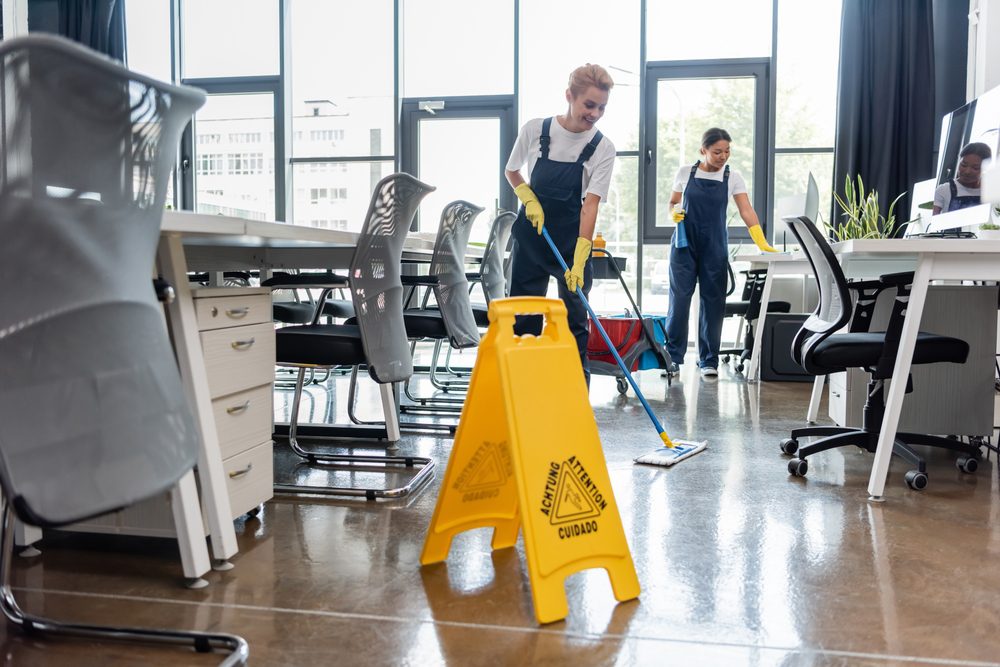
The difference between providers usually comes down to accountability – whether anyone has a stake in the standard holding six months in.
V.I.P. Home Services runs commercial cleaning through local owner-operator franchisees rather than rotating crews, and they’re police-checked, fully insured and trained to a national standard. State-based Operations Managers audit the work so standards are checked consistently.
V.I.P. is triple ISO certified – ISO 9001 for quality management, ISO 45001 for work health and safety, and ISO 14001 for environmental management. That matters practically as well as on paper: government contracts and supplier arrangements increasingly require ISO certification, so a certified provider can meet those conditions without holding up your tender. Cleaning uses GECA-certified products from the Enviroplus, Whiteley and Agar Green ranges, with hospital-grade disinfectants where a site requires them.
For businesses across more than one location, a single provider means national coverage, one point of contact and centralised invoicing, with a local franchisee at each site. If the work isn’t up to standard, V.I.P. returns to fix it at no charge.